
Application of Transformer Silicon Steel Core in Transformers
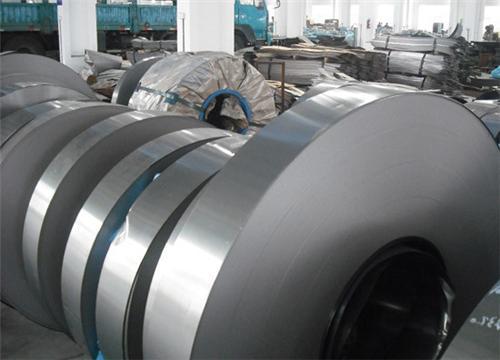
Transformers are now commonly used in power transmission and instrumentation equipment. In these two professions, their shapes are basically similar, but their materials are significantly different. The majority of iron cores in power transmission transformers are made of thinner silicon steel sheets, characterized by a full magnetic induction intensity of about 2T for BS; The instrument transformer is made of ferrite magnetic core material, with a characteristic of BS full magnetic induction intensity of about 0.3T.
Transformers are used for communication, and there are frequent irregularities in communication, and the transformer core cannot be fully filled during the operation process. In the early days, when transmitting electricity, transformers operated at the power frequency, with a relatively low frequency of 50/60Hz, but the operating current was relatively high. The losses are mainly concentrated in copper losses, and due to the high current, it is required that the full magnetic induction intensity of the transformer core material be relatively high.
Later, it was found that the iron core of power transmission transformers made of silicon steel sheets could be satisfactory at low frequencies and under high current operation, the iron core was not full. Therefore, the main reason for using thinner silicon steel sheet iron cores in power transmission transformers is that the magnetic saturation strength is relatively high.
With the addition of electrical equipment, there is an increasing demand for different power sources and devices with higher requirements for power quality. The development of power supply has evolved from rectifier or transformer to linear power supply, and then to switching power supply. The characteristic of transformers in switch mode power supplies is that the operating current becomes very small compared to power transmission. But in order to improve the efficiency of the power supply and reduce its size. The operating frequency of the switching power transformer ranges from 20K to 200K.
If the former silicon steel sheet is used, its resistivity is very low, and eddy current loss is the primary factor in high-frequency operation. In fact, it generates severe heat, which affects the application of silicon steel sheet in switching power supplies. So, ferrite core materials are presented. Its characteristic is that the magnetic saturation strength is not high, but for switching power supplies, it is basically not full. Its key advantage is that the resistivity is relatively high compared to silicon steel sheets, the eddy current loss is reduced, the heating is not as severe, and there is basically no problem in practical application.
Article source: Transformer silicon steel sheethttp://www.cheungshun.com/
-
08-27
What is the function of the iron core of the silicon steel sheet in a transformer
The commonly used transformer iron core is generally made of silicon steel sheets. Silicon steel is a type of steel containing silicon, with a silicon content of. 0.8%~4.8%. The iron core of a transfo
-
08-27
The difference between hot-rolled and cold-rolled silicon steel sheets for transformers
In daily life, silicon steel sheets are widely used in motor cores. However, in terms of manufacturing silicon steel sheets, there are two aspects: hot rolling and cold rolling. Many friends do not kn
-
08-27
Is it better for silicon steel sheets to have a higher silicon content
The silicon steel sheet manufacturer's answer is not really satisfied with thinner silicon steel cores with higher silicon content. In terms of standards, the silicon content of thinner steel cores do
-
08-27
The difference between silicon steel sheet and silicon steel sheet
silicon steel sheetElectrical silicon steel sheets are commonly known as silicon steel sheets or silicon steel sheets. It is an electrical silicon steel with a silicon content of up to 0.8% -4.8%, mad
Copyright © 2026 Jiangmen Cheungshun Electric Products Factory Co., Ltd. All rights reserved xml site map