
Why do transformers use silicon steel sheets as iron cores
The commonly used transformer cores are usually made of silicon steel sheets. Silicon steel is a type of steel made of silicon (also known as silicon), with a silicon content ranging from 0.8% to 4.8%. The iron core of a transformer made of silicon steel is due to the fact that silicon steel itself is a magnetic substance with strong magnetic conductivity. In the energized coil, it can generate a large magnetic induction intensity, which can then reduce the volume of the transformer.
We know that actual transformers always operate in AC state, and power loss is not only generated in the resistance of the coil, but also in the iron core under the magnetization of alternating current. The power loss in the iron core is usually referred to as "iron loss", which is caused by two reasons: hysteresis loss and eddy current loss.
Hysteresis loss is the iron loss caused by the presence of hysteresis in the magnetization process of an iron core. The magnitude of this loss is proportional to the area enclosed by the hysteresis loop of the material. The hysteresis loop of silicon steel is narrow, and using it as the iron core of a transformer has a smaller hysteresis loss, which can greatly reduce its heat generation
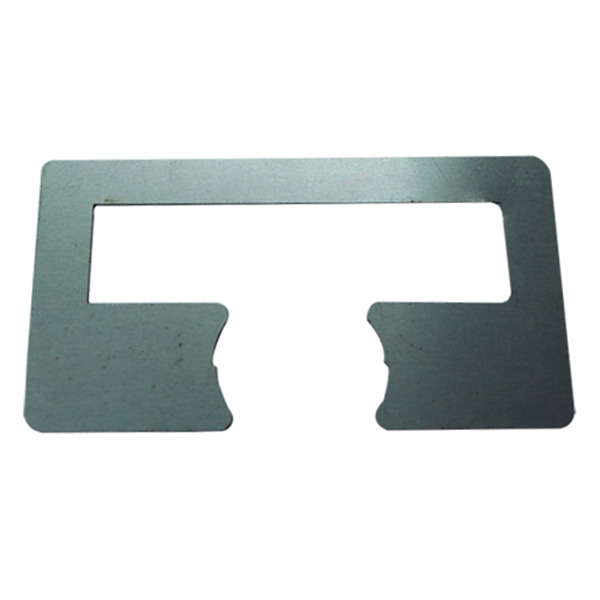
Since silicon steel has the above advantages, why not use a whole piece of silicon steel as the iron core for the oil cylinder, but process it into sheet shape?
This is because the sheet-like iron core can reduce another type of iron loss - "eddy current loss". During transformer operation, there is alternating current in the coil, and the magnetic flux it generates is of course alternating. The changing magnetic flux generates induced current in the iron core. The induced current generated in the iron core flows in a plane perpendicular to the direction of magnetic flux, hence it is called eddy current. The same eddy current loss causes the iron core to heat up. In order to reduce eddy current losses, the iron core of the transformer is stacked with silicon steel sheets that are insulated from each other, allowing eddy currents to pass through a narrow circuit with a smaller cross-section, thereby increasing the resistance on the eddy current path; Together, the silicon in silicon steel increases the electrical resistivity of the material and also reduces eddy currents.
The iron core used as a transformer is generally made of 0.35mm thick cold-rolled silicon steel sheets. According to the required size of the iron core, it is cut into long pieces and then overlapped into a "Japanese" or "mouth" shape. In theory, to reduce eddy currents, the thinner the thickness of silicon steel sheets and the narrower the spliced strips, the better the effect. This not only reduces eddy current losses and temperature rise, but also saves materials for silicon steel sheets. But in reality, when manufacturing silicon steel sheet iron cores. Not only from the above advantageous factors, but also because manufacturing the iron core in that way greatly increases the working hours and reduces the cross-section of the iron core. Therefore, when using silicon steel sheets to manufacture transformer cores, it is necessary to start from the specific situation, weigh the pros and cons, and choose the best scale.
Article source: Transformer silicon steel sheethttp://www.cheungshun.com/
-
08-27
What is the function of the iron core of the silicon steel sheet in a transformer
The commonly used transformer iron core is generally made of silicon steel sheets. Silicon steel is a type of steel containing silicon, with a silicon content of. 0.8%~4.8%. The iron core of a transfo
-
08-27
The difference between hot-rolled and cold-rolled silicon steel sheets for transformers
In daily life, silicon steel sheets are widely used in motor cores. However, in terms of manufacturing silicon steel sheets, there are two aspects: hot rolling and cold rolling. Many friends do not kn
-
08-27
Is it better for silicon steel sheets to have a higher silicon content
The silicon steel sheet manufacturer's answer is not really satisfied with thinner silicon steel cores with higher silicon content. In terms of standards, the silicon content of thinner steel cores do
-
08-27
The difference between silicon steel sheet and silicon steel sheet
silicon steel sheetElectrical silicon steel sheets are commonly known as silicon steel sheets or silicon steel sheets. It is an electrical silicon steel with a silicon content of up to 0.8% -4.8%, mad
Copyright © 2026 Jiangmen Cheungshun Electric Products Factory Co., Ltd. All rights reserved xml site map